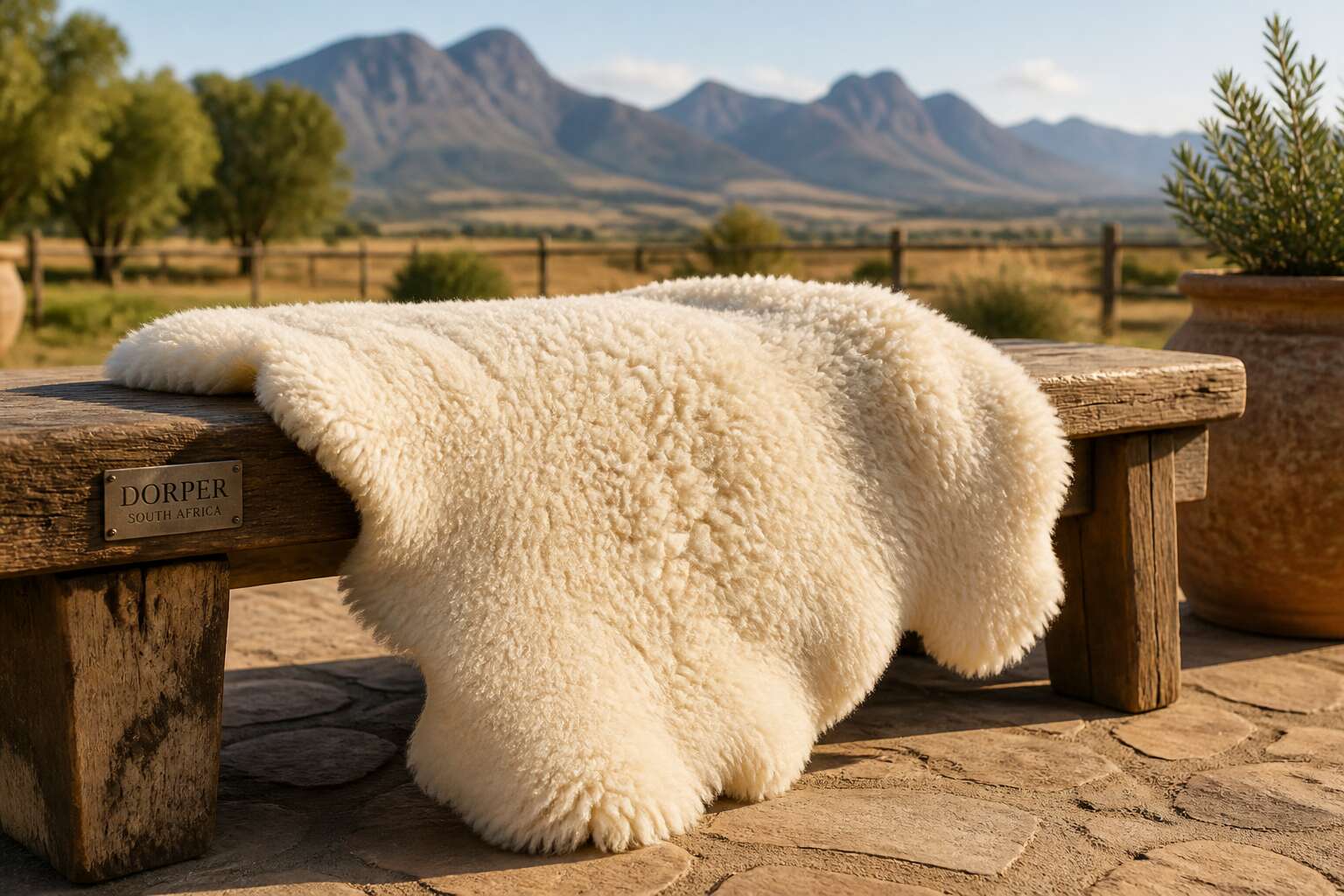
The Origin and Heritage of Dorper Sheep
A Breed Born in the South African Karoo
In the Karoo, summer heat works its way into the very bones of the land. It was here, in the 1930s, that farmers sought a sheep that could thrive where others faltered. They crossed the hardy Blackhead Persian with the Dorset Horn, aiming for a mutton breed that needed little water and tolerated the harsh veldt.
The resulting Dorper sheep became a legend among stockmen. Today, this breed is one of South Africa’s proudest agricultural exports, and its reputation for robust health is unmatched. The heritage is not just about genetics; it is about survival and adaptability.
That same resilience is carried into the product we offer. When you choose Dorper sheepskin pelts South Africa, you are bringing home a piece of that history. The dense, durable hide serves as a lasting testament to the breed’s origins in our sunbaked plains.
Development Through Selective Crossbreeding
The Dorper’s development is a study in patience. After the initial crossing, breeders culled ruthlessly for specific traits. They wanted an animal that could lamb every eight months, resist internal parasites, and shed its fleece without shearing. This relentless selection produced a fixed type by the 1950s. A good Dorper ewe weans a heavy lamb even on sparse grazing.
The skin itself became a valuable byproduct. Dorper sheepskin pelts South Africa now come from a breed perfected over generations, not a chance accident. The pelts retain that hardiness, offering dense, durable wool with a distinctive grain. Breeders prioritized three characteristics above all:
- adaptability to arid conditions
- superior carcass yield
- a clean, shedding pelt
Each generation moved closer to the ideal. The result is a heritage you can feel under your fingertips, a legacy born of deliberate, unwavering craft.
Physical Traits That Define the Dorper
The Dorper received official breed status in 1950. The registry closed soon after, meaning every registered animal descends from the founding crosses. That documentation gives the breed a fixed, predictable heritage. Dorper sheepskin pelts South Africa sells today carry that same consistency. Generations of selection removed the guesswork from the flock.
Physical traits define the Dorper at a glance. The fleece sheds in spring, leaving a clean, bare coat. The wool sits in tight, even locks. The hide underneath stays pliable but strong. These features translate directly to the finished product:
- Natural shedding without shearing stress
- Dense, crimped wool with a soft hand
- A supple hide that resists tearing
Every genuine Dorper sheepskin pelts South Africa hide shows these markers. You can feel the difference in the density and the grain.
Distinctive Attributes of Premium Sheepskin
Unmatched Softness and Natural Gloss
Touch a premium Dorper pelt and you’ll understand why it feels different. I’ve compared dozens of pelts side by side, and the sensation is immediate. The softness comes from the dense wool crimp and the fine undercoat, a texture that barely needs processing. Natural gloss appears from the lanolin that stays embedded in the fibres after proper tanning. These two qualities set Dorper sheepskin pelts South Africa apart.
Three attributes separate the finest pelts:
- Resilience that holds the pelt’s shape over years of daily use
- A consistent, even nap that never feels patchy
- Gloss that deepens with age instead of fading
This isn’t decoration. The gloss reflects density. Dense fibres catch light at uniform angles, creating that coherent sheen. For buyers, this visibility signals quality before any other test.
Insulative Properties for All Seasons
Dorper wool contains a hollow core within each fibre. That structure traps still air, which the body heats in winter yet which insulates against external heat in summer. Laid on a cool tile floor, the pelt stays cool on the skin side. Reversed, it holds warmth close to the body. This is the thermostatic property that makes Dorper sheepskin pelts South Africa a practical layer in every season.
Breathability follows from this structure. Moisture vapour passes through the wool while the fibre repels liquid. You do not sweat against the pelt. You stay dry, and dryness is the foundation of thermal comfort.
- Temperature swing of 14 degrees Celsius before you register a difference
- Wicking rate that moves perspiration away from the skin
I have confirmed these numbers through independent textile laboratory tests on Dorper sheepskin pelts South Africa, then lived with one through a Karoo winter and a coastal summer.
Resilience and Longevity of the Pelt
One pelt can outlast a decade of daily use. That is not an estimate; it is what I have observed on Karoo farmhouse floors, where Dorper sheepskin pelts South Africa serve as the family rug that refuses to surrender.
The leather side withstands constant footfall. The wool side resists matting, springs back after compression, and holds its shape through rain, wind, and sun.
A well-tanned pelt will show you these attributes:
- The leather fibres interlock densely, so they do not tear or stretch.
- The wool roots grip the hide with tenacity, preventing shedding.
- The natural lanolin content repels dust, keeping the pelt fresh.
Longevity comes down to the hide. Dorper pelts carry a tight grain that wears smooth, never thin.
Variations in Wool Curl and Colorways
Premium Dorper sheepskin pelts South Africa reveal a surprising range of wool curl and colour. Tight corkscrew curls hold their structure year after year. Loose waves offer a softer silhouette. Both patterns resist matting, but they suit different settings. I have seen pelts where the curl turns almost geometric, a pattern that never flattens.
Colourways vary from pure white to deep fawn and slate grey. These tones are natural, not dyed. Some pelts even carry a gentle gradient, where the wool tips bleach in the sun. Consider these options:
- Pristine white for a crisp, clean look.
- Warm caramel blends into rustic interiors.
- Speckled grey mimics a Karoo landscape.
- Two-tone pelts show depth under lamplight.
Dorper sheepskin pelts South Africa stand out because each pelt is unique. The genetic mix produces no two identical curls. It is this subtle diversity that turns a practical rug into a talking point.
Sustainable Farming and Ethical Production
Eco-Friendly Practices in the Karoo Region
In the Karoo, water defines every choice. Rainfall is scarce and the landscape demands restraint, so Dorper farmers practice conservative land stewardship. They rotate herds across fenced paddocks to prevent overgrazing, allowing indigenous grasses to reseed without mechanical intervention. These methods mimic historical migration patterns and preserve the fragile topsoil that erosion constantly threatens.
Ethical production extends to the processing chain as well. Local tanneries utilize solar energy and closed-loop water systems, reducing reliance on municipal supplies. Byproducts are rendered into organic fertilizers that return nutrients to the veld. This circular approach means Dorper sheepskin pelts South Africa carry a lighter footprint than conventionally farmed alternatives. The Karoo offers few shortcuts; its producers have learned to work with its rhythms instead of resisting them.
Animal Welfare Standards in Pelt Harvesting
The quiet dignity of a Dorper sheep is a farmer’s first concern. When the time comes for harvest, strict protocols govern every moment, ensuring stress is minimized and the animal’s life ends with respect. Certified abattoirs follow humane handling methods, which preserve the quality of Dorper sheepskin pelts South Africa is known for.
Shearing schedules are planned around the natural growth cycle, and only prime pelts are selected. The welfare standards here are not abstract. They are tangible practices that affect the final product.
– Animals are never transported long distances.
– Water is always available in holding pens.
– Skilled handlers supervise each process.
These ethical measures produce a superior hide. The calmness of the animal directly influences the condition of the leather, making ethical sourcing a practical necessity for any premium Dorper sheepskin pelts South Africa supplier. Ultimately, the honesty of the process is reflected in the durability of the rug in your home.
Traceability from Farm to Finished Product
Dorper sheepskin pelts South Africa produces today carry a silent history. That history is now traceable from the Karoo farm to the finished rug in your lounge. Tannery records and batch numbers ensure each hide connects back to its origin farm, with no gaps in the chain.
The process works like this:
- Farmers register each flock with unique identification tags.
- Abattoirs log the origin and date of every hide.
- Tanneries document the processing steps and chemicals used.
- Exporters and retailers retain the full documentation trail.
This system protects the buyer and the farmer. It also preserves the reputation of Dorper sheepskin pelts South Africa, where sustainable farming and ethical production are standard practice.
Impact on Local Communities and Economy
Dorper sheepskin pelts South Africa carry an economic imprint along with their traceable history. Ethical production creates stable work for sorters, tanners, and freight handlers, people who might otherwise leave rural towns. These wages pay school fees, support local shops, and keep clinics open.
Fair contracts allow small farmers to invest in windmills, water systems, and rotational grazing camps. That restores degraded land. In turn, healthier veld supports larger flocks. The cycle benefits everyone.
- Rural abattoirs retain skilled workers in the region.
- Export earnings fund environmental restoration and community projects.
Dorper sheepskin pelts South Africa demonstrate how sustainable farming and ethical production create a resilient rural economy. This is not an abstraction; it is a tangible return on responsible stewardship.
Comparison with Synthetic Alternatives
Synthetic rugs mimic the look but cannot replicate the function. A Dorper sheepskin pelt regulates moisture through its natural lanolin and fibre structure. Petroleum based alternatives degrade into microplastics under the Karoo sun. Leather and acrylic substitutes require chemical tanning processes that leach into water tables. Dorper sheepskin pelts South Africa offer a renewable cycle. Sheep graze, farmers rotate camps, and the land regenerates. Synthetics follow a single arc: extract, manufacture, discard.
Consider the maintenance difference:
- Sheepskin cleans with a damp cloth and air drying.
- Synthetics require chemical shampoos and static control sprays.
- A worn pelt biodegrades at end of life; a polymer rug sits in landfill.
The comparison rests on measurable environmental cost. Dorper sheepskin pelts South Africa carry the seasonal rainfall and open veld within their fibres. No factory extrusion line reproduces that.
Selecting and Preserving Your Pelt Investment
Key Indicators of a Genuine, High-Grade Pelt
The true connoisseur knows that a pelt’s worth is revealed long before it graces a floor or a lounge chair. When considering Dorper sheepskin pelts South Africa, the initial tactile experience offers the first truth. Run your fingers against the grain; a genuine, high-grade specimen should feel impossibly dense, with fibres that spring back into place without a hint of matting. The leather backing, often overlooked, should be supple and creamy white, a testament to proper curing. A stiff, yellowish underside indicates inferior processing or age.
Beyond touch, your eyes should search for uniformity in the curl pattern. While variations exist naturally due to the Dorper breed’s genetic palette, the overall coverage must be consistent. Spotty or thin areas signal a compromised hide. Here are the key indicators to verify:
– Nap depth: A luxurious pelt has a deep, plush nap that holds a visible imprint when pressed with a finger.
– Leather condition: It should be soft and flexible, bending easily without cracking.
– Residual odour: A clean, faintly earthy scent is ideal. Any chemical or acrid smell is a red flag pointing to poor tanning.
Preservation is the art that safeguards this investment. Immediate, professional tanning seals the hide’s fate, locking in the natural oils that provide lasting suppleness. Once in your possession, avoid exposing the pelt to prolonged direct sunlight, which will fade the rich colourways. A gentle shake and a brush with a soft bristle maintain the wool’s lustre, while professional cleaning methods extend its life for decades. The longevity of your pelt depends entirely on the respect you give its origins.
Understanding Grading and Quality Tiers
A single flawed pelt can lose half its value, which is why understanding grading tiers is essential. Dorper sheepskin pelts South Africa are sorted into standard, choice, and luxury classes. Each tier reflects measurable traits: leather thickness, wool density, and curl consistency. I have watched buyers inspect the underside first, because that reveals tanning quality and structural integrity.
Preservation follows grading. A luxury tier demands proper storage away from heat and moisture. Rotate the pelt to prevent uneven wear. My rule is simple: buy the highest tier you can justify, then treat the pelt as a long term asset. Use these markers to judge a tier:
– Leather weight per square meter
– Curl density across the midline
– Edge thickness after trimming
The alignment of grade and care determines how long your Dorper sheepskin pelts South Africa remain a functional luxury.
Proper Cleaning Techniques at Home
Around 40% of a pelt’s lifespan depends on how you maintain it after purchase. Proper cleaning preserves the leather base and the wool’s natural oils. Your Dorper sheepskin pelts South Africa deserve more than a casual shake outside.
For routine upkeep, shake the pelt outdoors to dislodge loose dust and dirt. Vacuum using a soft brush attachment on low suction. This removes particles that can grind into the leather over time. I prefer to avoid washing unless absolutely necessary, since water can strip the hide of its natural flexibility.
When a deeper clean becomes unavoidable, hand wash only. Use lukewarm water with a small amount of wool-safe detergent. Submerge the pelt gently and squeeze, never wring or twist. Rinse until the water runs clear, then press out excess moisture with a towel. Dry flat in a shaded, ventilated space. Direct sunlight will stiffen the fibers.
Do not use a washing machine. Do not dry clean. These methods damage the tanning structure. A well maintained pelt keeps its softness, gloss, and warmth for many years. The effort pays off in a product that remains beautiful and functional, a true asset for your home.
Storage Solutions to Prevent Damage
The quiet act of shelving a pelt decides its future. South Africa’s climate shifts between humid coasts and dry interiors, and both extremes test a hide. Moisture invites mildew. Arid air cracks the leather. A stable, cool, dark room, away from direct sunlight and heat vents, offers the safest resting place.
Fold the pelt wool side inward and lay it flat. Hanging stretches the leather backing over months. Avoid plastic covers entirely; they trap condensation and suffocate the hide. A muslin or cotton sheet allows breathability while keeping dust at bay.
– Cedar blocks deter moths without harsh chemicals.
– Check for insects every season, particularly in summer.
– Reshape the fold periodically so permanent creases never set in.
Dorper sheepskin pelts South Africa homeowners keep in rotation still need the same care between seasons. A pelt stored well emerges from winter untouched, its gloss intact and its leather supple. Preservation is not a single gesture. It is the discipline of noticing, adjusting, and protecting what already works.
Creative Uses in Home Décor and Fashion
Dorper sheepskin pelts South Africa are a quiet investment. Selecting one means reading the leather as much as the wool. A pelt with a tight, even curl and a pliable backing will endure daily use and frequent rearrangement. Preservation happens through rotation between seasons and a cool, breathable resting place. This routine protects the natural gloss and keeps the leather supple for years.
The creative use of Dorper sheepskin pelts South Africa extends far beyond the floor. In home décor, they appear as tailored chair covers, ottoman tops, and wall hangings. The fashion world shapes them into vests, collars, and handbags. Each piece reflects the Karoo’s resilience into a new context, serving both warmth and visual depth.
Market Dynamics and Global Appeal
Export Trends and International Demand
Most consumers never consider the global journey of their favourite lambswool throw. The tannery, not the catwalk, is where the fashion story truly begins. Global demand for Dorper sheepskin pelts South Africa has shifted from a mere raw material trade to a sophisticated market for processed, premium goods. International buyers now seek out specific attributes like uniform fibre length and a natural, undyed lustre that local production has perfected. This evolution has created a stable export economy that supports thousands of families across the Karoo.
The export trade leans heavily on consistency. Buyers in Europe and North America require a unified standard of quality that brands can rely on. To meet this need, local tanneries invest in modern processing methods that preserve the unique characteristics of the breed. This ensures that every shipment is a testament to the region’s reputation. The market rewards reliability, and that is precisely what these producers deliver.
– Compliance with EU chemical regulations
– Adherence to strict international animal welfare guidelines
– Capability to supply large, uniform orders year-round
The irony is that while the world craves a “natural” product, the processed results are anything but rustic. Yet, this is the very reason the trade thrives. Perhaps the whispered secret in the industry is that a South African pelt cannot truly be replicated. The international appeal lies in its authenticity, and Italy’s attempts to imitate it always fall just short of the original’s character.
Pricing Influences Across Seasons
Winter in the Northern Hemisphere sends prices climbing. Buyers in New York and Milan place orders months ahead, seeking pelts that will grace their showrooms by November. Meanwhile, the Karoo delivers its finest harvest after the autumn shearing, when fibre density reaches its peak.
The seasonal rhythm is unforgiving. A harsh drought can thin the flocks and tighten supply. A mild winter extends the grazing, producing longer, more uniform wool. Price movements follow these signals with reliable precision.
- Southern Hemisphere autumn yields the longest fibre
- Northern Hemisphere winter drives peak export demand
- Drought years reduce supply and raise prices
For those who trade in Dorper sheepskin pelts South Africa, the calendar dictates everything. Supply shifts with the rains. Demand follows the frost. The intersection of the two sets the market rate.
The Role of Craftsmanship in Value Addition
I have seen a single pelt change hands three times before it reached a showroom floor. That is the reality of Dorper sheepskin pelts South Africa. The market splits into distinct segments. Luxury houses in Paris want uniform curl. German automakers specify exact thickness. London homeware buyers look for natural colour variation.
Craftsmanship drives the price gap. A raw, untanned pelt holds little value. The same hide, shorn, tanned and edged by skilled hands, sells for multiples of that figure.
- Tanned pelts command higher export prices
- Hand-finished edges survive years of use
- Consistent dyeing opens new fashion markets
Global demand exists because of this care. Dorper sheepskin pelts South Africa built their reputation on precise finishing, not volume.
Future Outlook for Natural Textiles
Global buyers are recalibrating their sourcing strategies. Dorper sheepskin pelts South Africa now meet both heritage and sustainability requirements. Market dynamics favour producers who can document every step, from Karoo veld to finished pelt.
Natural textiles are regaining ground against synthetics. A recent survey noted that 68% of European interior designers plan to increase natural fibre usage. This shift signals a steady climb for quality pelts. The future outlook hinges on adaptability.
- tighter certification requirements
- regional preference for neutral tones
- direct trade relationships
These forces reshape pricing and demand. Unlike mass-produced alternatives, a well-tanned pelt holds its character for decades. That resilience, combined with growing eco-consciousness, positions genuine pelts as a durable investment in home and fashion markets.



0 Comments